Digital Artifact Report
- es50055

- Oct 27, 2022
- 6 min read
The media niche I chose for this DA is University students living out of the home. The development of the media niche derived from reports outlining the correlation between health, health behaviour and educational achievement. Research demonstrates the importance of balance and maintaining a healthy lifestyle for students to succeed at University. The problem I was able to identify through reading was that there was limited social media content designed for University students that had to balance living out of home, working casually, budgeting and finding time to work out.
I wanted my DA to address key issues that University students were experiencing only having satisfactory diets, limited nutritional knowledge and physical activity and high levels of stress and depression. I used problematising and contextualising to identify these core issues and form my DA through this research. My DA aims to provide University students with social media content that is realistic and budget-friendly and offer suggestions for meals, workout plans or how to structure a ‘productive’ uni day.

I knew I could produce relevant content for this DA due to participant observation. I am a University student that works 20+ hours a week, lives on a budget and struggles to find a healthy balance that will allow me to perform well at Uni. Based on my own needs, I was able to create and develop content that would benefit me as a viewer and others within this niche. My content includes meal plans and ideas designed for University students living on a budget. With University students experiencing financial behaviour problems, I could identify this issue and make content to help solve the problem.
Auto ethnography has allowed me to analyse my personal experience to understand the cultural experience better. Epiphanies have been a key element of my DA in providing insight to content that would greatly benefit my niche and give my DA purpose by analysing my own lived experience within this niche. An epiphany explored in my blog post on epiphanies, many girls neglect working out in a gym due to being intimidated and not knowing what to do. This has much to do with feeling self-conscious and other gender-specific deterrents discouraging female participation. For this purpose, I wanted to develop easy-to-follow workouts that girls could do at the gym and can easily be regressed. However, I also want to include more workout content for “shy” girls that use none of the large weight machines and can be all done in a small space.
The other epiphany explored in this blog post was the importance of my DA. This epiphany was how at least one of the videos I post could make a small, positive impact on a University student’s life or be a catalyst for change. Whether it is a meal idea, it could become a “go to” for students on a tight budget or a workout they might use weekly. These videos could help University students improve their balanced lifestyle short term or hopefully long term. This epiphany outlines the true purpose of the DA, which is to help solve a problem, and my DA could do this even if it only effectively helps just one student within this niche. This was a transformative moment in the development of my DA, as it gave me the purpose to help insiders (cultural members) and outsiders (cultural strangers) to understand better the culture surrounding University students that live out of home (Ellis et al., 2010). To create an auto ethnographic product, I have designed an aesthetic and evocative that focuses on an engaging and informative persona (Ellis et al., 2010). I achieved this by using a conversational tone, emphasising my interaction with myself and others, bringing my niche audience into the scene and making an engaging and rich DA.
My online persona was designed to be approachable, relatable, friendly and informative for viewers. I used observation and auto ethnographic research to look at influencers with similar content, such as Rachel Dillon. I examined her online persona as if she has drawn a large following and launched two successful businesses, largely due to her being a likeable persona for her audience. Rachel produces content such as meal ideas, workout ideas and “day in my life” content. However, her workouts do fail to cater to university students who live out of home and on a budget, as her meals are not affordable for many people. In addition, her workouts can require a lot of machines and require knowledge of form and technique. Based on this, my DA offers cheaper, healthier alternative meals and workouts that use less equipment, making them ideal for University students that need guidance, inspiration and support whilst studying and living out of the home.


As communicated in my original blog post I chose to build my online presence on TikTok. TikTok is the largest growing social media platform. A large portion of users are within the University student age bracket, with 60% of users aged between 16 to 24 years old. To increase my reach within this niche, I utilised hashtags and trending sounds. I made a public account to allow users access to more content on my account without waiting for pending approval. This also allowed my content to be shared more easily. Hashtags were key in engaging in this niche, as they allowed my content to be shown to users that engaged with similar content. Hashtags also allow users to ‘move in non-linear directions’ and engage with content they have something in common.
Auto ethnography helped me participate as an audience member in my media niche through problemitisation, field mapping, epiphanies, narrowing, approach and contextualising. Problemitisation involved me using readings, reports and my own experience within this niche to uncover an issue which was a lack of social media content to support and assist University students living out of the home. This leads me to look into assumptions of University students having a “fun” and “easy” life. There is little acknowledgement of the other problems. University students have outside of Uni such as work, social commitments, financial stress, physical activity and diet, which cause University to struggle to find a healthy balance.
Field mapping has allowed me to define further and narrow the field of University students living out of the home. The field mapping explored in my blog post, gave me a visual understanding of the different social dynamics of my niche and the content that should be produced to address the problem. It gained insight into the data I should focus on to develop my DA to make it as useful as possible for university students by looking at similar creators within similar niches, different social media platforms affordances and ideas of content I should include. It also assisted my ability to narrow down my niche so that it is highly specific and not broad and gave me a stronger approach when engaging in ethnography.
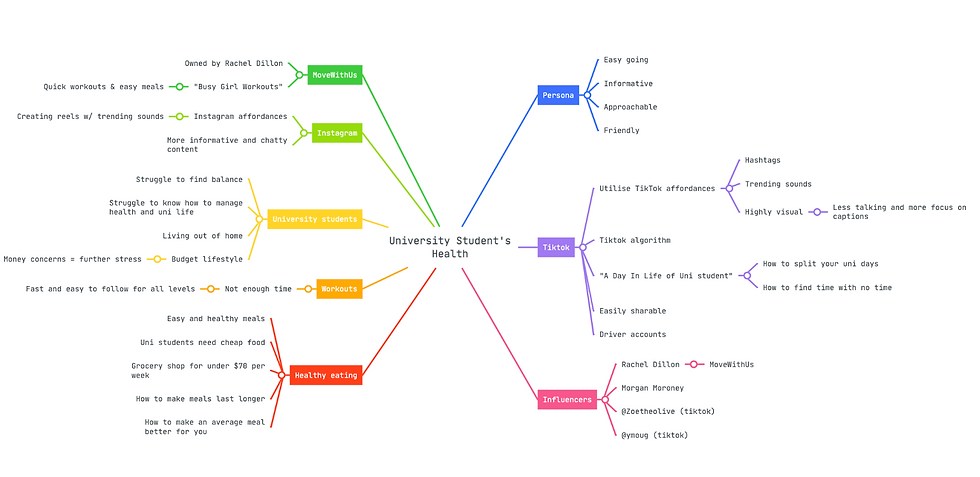
In digital ethnography, my DA is very reflexive, as we learnt in the Week 6 lectures, because my personal experiences within this niche have helped me understand my audience. Reflexivity has allowed me to observe and participate in the media niche. I have used the walk-through method to focus on my own experience and how I have chosen to navigate and interact with content within this niche (Moller et al., 2019). I have integrated spatial and temporal analyses of human and media interactions by understanding this concept. I have engaged with influencers on TikTok, such as Rachel Dillion, Morgan Moroney, zoetheolive (TikTok) and ynoug (TikTok), to analyse their persona and hear about their experiences and knowledge for maintaining a balanced lifestyle. Whilst some of these influencers are not creating content specifically for university students, their persona, online presence, and content still inspire my DA.
Currently, my DA is only on the digital platform of TikTok, which has limited the reach somewhat, but in the future, I would like to introduce the content to Instagram. I am working towards my certificates 3 and 4 in fitness, so once I gain these qualifications and do a nutrition course, I will bring my DA to Instagram. This would allow me to provide my audience with knowledge from a certified trainer, and I would feel more comfortable posting content on multiple platforms. However, due to the nature of TikTok, only using one platform has worked quite well, as I have utilised trending sounds and hashtags to reach my audience. In addition, TikTok makes the content more highly discoverable to new audiences than Instagram.
The ethnographic research that went into my DA was extensive, and I was successfully able to create content that appealed to my niche. Still, there is always room for improvement in the frequency and quantity of content posted, which was reduced due to other commitments.
5 Minute Video
References
Ellis, C., Adams, T.E. and Bochner, A.P., 2011. Autoethnography: an overview. Historical social research/Historische sozialforschung, pp.273-290. Accessed: October 20, 2022
Møller, K. and Robards, B., 2019. Walking through, going along and scrolling back: Ephemeral mobilities in digital ethnography. Nordicom Review, 40(s1), pp.95-109. Accessed: October 20, 2022


Comments